
What Is Microcurrent Neurofeedback? A Plain-English Guide
Most people hear about microcurrent neurofeedback from a friend, not a doctor. Somebody they trust says it helped them sleep, or settle, or feel less on edge, and now they’re searching the term and finding a mix of glowing testimonials and technical jargon. Neither is much use if what you actually want to know is: what is this, and is it legitimate or is it crystals?
Fair questions. Here’s our attempt at answering them without a sales pitch.
The basic idea
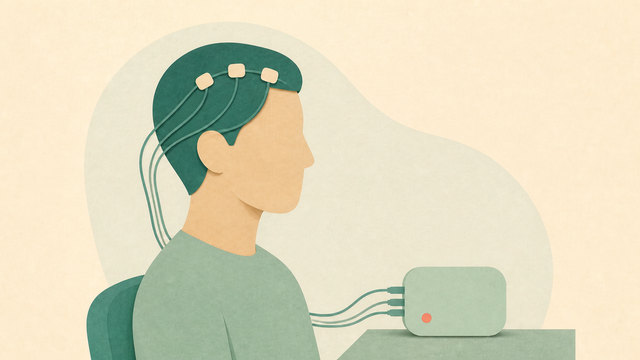
Microcurrent neurofeedback (MCN) is a gentle, non-invasive approach that works with the brain’s electrical activity. Small sensors go on your scalp. They read your brainwave patterns, and the system responds with a feedback signal so faint that most people feel nothing at all. The current involved is a tiny fraction of what a single AA battery produces.
The working idea goes like this. Brains settle into ruts. A nervous system that has spent years braced for trouble can keep bracing long after the trouble has passed, the way a jaw stays clenched hours after the stressful meeting ends. The feedback signal is thought to briefly interrupt those well-worn patterns, giving the brain an opening to reorganize on its own terms. Nothing pushes it toward a target. The interruption is the whole intervention.
You may notice the hedged language in that paragraph. “The working idea.” “Is thought to.” That’s deliberate, and we’ll get to why in a minute.
What it asks of you
Almost nothing, which is genuinely one of its distinctive features. You sit in a comfortable chair. Sensors go on. You chat, or sit quietly, or stare out the window. Sessions are short, typically well under an hour, and afterward you go back to your day.
That passive quality is a big part of who MCN appeals to: people who are tired of working so hard at feeling better. If you’ve talked, journaled, breathed, and white-knuckled your way through years of effort, an approach that asks nothing of you can sound almost too good. Which brings us to the evidence.
What we observe, and what we can’t claim
If you read only one section of this page, make it this one.
Clinically, many of our clients report feeling calmer, sleeping better, or being less reactive — sometimes within the first handful of sessions, sometimes more gradually. Practitioners around the country describe similar patterns. Those reports are consistent enough that we offer MCN and think it’s worth considering.
What the reports are not is proof. MCN is a newer approach, and the research hasn’t caught up with the clinical enthusiasm. There are promising early studies and a great deal of practitioner experience, but not the large, rigorous controlled trials that stand behind approaches like CBT. So we can’t honestly tell you that MCN treats or cures any condition, and we won’t. Anyone who does is out ahead of the evidence. Some of what people experience may involve expectation effects; only better research will sort that out.
If that uncertainty is a dealbreaker for you, that’s a reasonable place to land, and we’d rather you know the state of the science now than feel misled later.
Not a replacement for therapy
One thing we hold firm on: MCN at our center lives alongside counseling, never instead of it. If MCN helps a keyed-up nervous system settle, therapy is where you do something with the settling — understand the patterns, build the skills, work through whatever the bracing was about in the first place. And if you’re in crisis or managing a serious condition, therapy and appropriate medical care come first. Full stop.
Is it safe?
MCN is non-invasive and generally well tolerated. The most commonly reported effects are mild and temporary: brief fatigue after early sessions, or occasionally feeling a little wired. Whether it makes sense for your particular situation is a conversation rather than a blog post, and we’re glad to have that conversation without any assumption that you’ll say yes.
Curious whether MCN makes sense alongside your care? Get started, or ask for a call and we’ll give you the same straight answers in person. Learn more about MCN therapy at Austin Mindfulness Center.