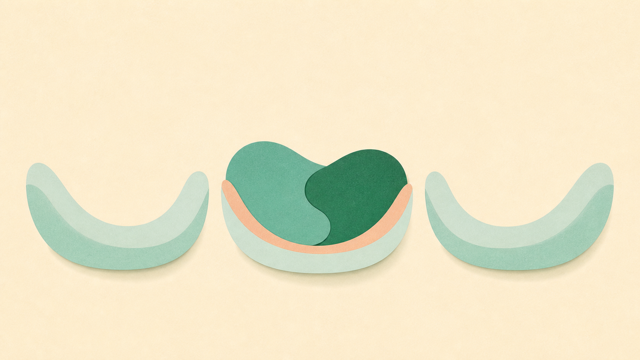
Why You Keep Having the Same Argument
The topic rotates. The fight doesn’t.
Monday it’s the dishes. Thursday it’s the phone. Next week it’ll be the thing that was supposed to be handled, and within four exchanges you’re both reciting lines you’ve said a hundred times. One of you gets louder and more insistent. The other goes quiet or leaves the room. Nothing resolves, and you both go to bed certain the other one started it.
Most couples assume that’s a hundred different arguments. It’s usually one argument wearing a hundred costumes, and almost nobody can see that from inside it.
The argument isn’t about the dishes
If the fight were really about dishes, a chore chart would have ended it years ago. The reason it survives every solution you throw at it is that the topic isn’t the subject. The subject is what the topic means to each of you.
Underneath “you never do the dishes” there’s usually something closer to I feel alone in this. Do I matter to you? Underneath the silence or the eye-roll on the other side: nothing I do is ever enough, so why try? Neither message gets said out loud. You can’t resolve a conversation you’re not actually having, which is why this one never ends.
The loop has a name
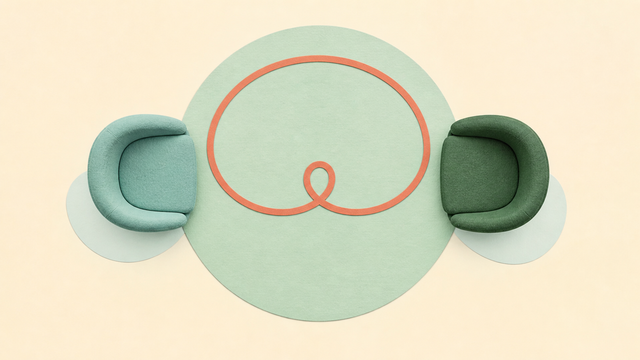
Therapists call it the pursue-withdraw cycle, and it is the single most common pattern that walks through our door.
One partner, the pursuer, feels the disconnection and moves toward it: raises the issue, asks the questions, pushes for the conversation. The other, the withdrawer, feels that intensity as pressure or criticism and moves away to keep the peace: goes quiet, changes the subject, agrees to anything just to end it.
The cruel mechanics of the thing: each person’s coping strategy is the other person’s trigger. Withdrawing feels like abandonment to the pursuer, so they pursue harder. Harder pursuit feels like attack to the withdrawer, so they withdraw further. Both people are trying to protect the relationship, one by fighting for contact and one by preventing a blowup, and their two protections mesh into a machine that makes them both lonelier.
If you recognize your role, notice something else. You’ve probably assumed the other role was the problem. Pursuers think if they’d just engage, we’d be fine. Withdrawers think if they’d just calm down, we’d be fine. You’re both half right, which is another way of saying the cycle is the problem and neither of you is.
Why trying harder makes it worse
The obvious fixes feed the loop. Pursuing more skillfully — better arguments, better timing, a bulleted list — still lands as pressure. Withdrawing more gracefully, staying in the room but going blank, still lands as distance. You cannot out-argue this pattern or out-silence it, because it runs on the pursuing and the withdrawing themselves, not on who’s right.
Physiology is part of why. Past a certain intensity, an argument stops being a conversation and becomes what Gottman researchers call flooding: heart rate up, thinking narrowed, nobody able to take in a word. The same two reasonable people keep having the same unreasonable ninety seconds.
What interrupts the loop is something neither role does naturally: naming the cycle instead of playing your part in it. “We’re doing the thing” is a genuinely different move than another lap around the track. So is the pursuer saying the softer sentence under the loud one — I miss you instead of you never — and the withdrawer saying what the silence has been protecting: I go quiet because I’m scared of making it worse, not because I don’t care.
Simple to describe. Very hard to do mid-fight, with your heart pounding and twenty years of script memorized. Which is why this particular problem responds so well to having a third person in the room, someone who can spot the cycle starting before either of you can and slow it down enough for the real messages to finally get said.
The hopeful part
Couples often arrive assuming that fighting this much means something is fundamentally broken. Usually it means the opposite. You’re both still fighting for the relationship, just in ways that cancel each other out. The couples who worry us aren’t the ones stuck in this loop. They’re the ones who’ve stopped bothering to run it.
If you just recognized your last three arguments, that recognition is the first step out of the loop. Get started, or ask for a call if you’d rather talk it through with a person first — including how to bring the idea to your partner. Learn more about couples counseling at Austin Mindfulness Center.