
School Refusal Is Usually Anxiety, Not Defiance
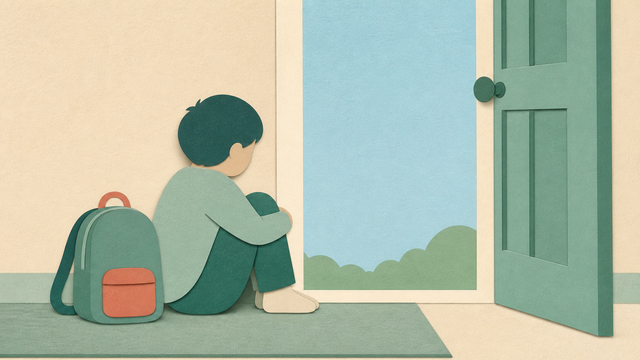
Most mornings that end with a child on the floor by the front door are not discipline problems. They’re fear problems. The distinction matters more than it sounds like it should, because it decides everything you try next.
You’ve probably already tried gentle. Then firm. Then the sticker chart, then the calm Sunday-night conversation where everyone agreed this week would be different. Then Monday came.
Fear in children almost never announces itself as fear. It announces itself at 7:40 in the morning as a stomachache.
Why they seem completely fine by ten o’clock
Children who are anxious about school tend to develop real physical symptoms — stomachaches, headaches, nausea — that show up in the morning and ease considerably once staying home has been settled (American Academy of Family Physicians). By mid-morning the color is back in their face and they’d like to know what’s for lunch. It is very hard not to read that as proof you’ve been had.
Look at the sequence again, though. The symptom appeared when school was imminent and faded when it wasn’t. That isn’t evidence the pain was invented. It’s evidence about what caused it. The relief is the tell.
Timing helps too. This tends to arrive around ages five to seven, and again around eleven to fourteen — the two big school transitions (AACAP) — and after breaks in routine: a long summer, a stretch home sick, a move, a loss. If this showed up in late August, you’re not watching a personality change. You’re watching a transition, with your child’s alarm system running hot.
Refusal and defiance look identical from the hallway
From where you’re standing, late for work, one shoe in your hand, a child who won’t go to school looks exactly like a child who has decided not to.
There’s a useful distinction underneath, though. Truancy is concealed and largely untroubled — the kid is somewhere else and fine about it. School refusal is close to the opposite. Your child is home with your knowledge, visibly miserable about it, and very often wishes they were the kind of kid who just goes. Nobody is winning anything here. They’re stuck.
The behaviors that look most like manipulation — the escalating, the pleading, the promises about tomorrow — are usually what panic looks like in someone who hasn’t got better tools yet.
Why both of your instincts backfire
Most parents oscillate between two responses, and both come from love.
“We’re going. Get in the car.” Force without doing anything about the underlying fear usually raises it, and your child learns that the person they’d most like comfort from is also the person delivering them to the thing they’re frightened of.
“Fine — stay home today.” Understandable, and it works for roughly four hours. But relief is a powerful teacher, and avoidance that gets rewarded tends to grow. Tomorrow morning is now slightly harder than this morning was.
Neither instinct is stupid. They’re just the two options that don’t work on their own.
The part that’s harder to hear
Time is not neutral here. The sooner a child gets back into school, the better things tend to go, which is why clinicians treat this as something to address now rather than watch for a few more weeks (Child Mind Institute). Every day out, the building gets a little bigger in your child’s mind. “Wait and see” is the most common advice parents get, and in this particular situation it’s the wrong advice.
What actually helps
Find out what the fear is about. School refusal is a behavior, not a diagnosis. Underneath it might be separation anxiety, social anxiety, low mood — or something at school a child is entirely rational to want to avoid, like bullying. The plan depends on which one you’re dealing with.
Go back in steps, not one leap. Part of a day. A favorite class. A quiet arrival before the hallway fills. Repeated experiences of coping are what shrink the fear.
Get the school on the team. A named adult, a place to go when it spikes, an agreed signal. Most Austin schools have done this before — more often than they advertise.
And get coached yourself. Most of this work happens in your hallway on a Tuesday morning, not in our office. What you say, and what you do when they cry, matters more than anything we manage in fifty minutes.
You noticed
Parents arrive apologetic almost every time. Sorry for taking the appointment, sorry it took them this long to call. We see this every single August. It’s one of the most common reasons a family calls us, and it responds well to the right kind of help, particularly when that help starts early. You took it seriously instead of assuming it would pass. That isn’t overreacting.
If mornings have become a battle at your house, we can help. Our therapists work with school refusal often. Get started, or if you’d rather talk it through with a person first, ask for a call. Learn more about child counseling at Austin Mindfulness Center.