The Wrong Color Cup: What Big Outbursts Really Mean
You handed over the blue cup. They wanted green. Four minutes later there is screaming, there are tears, and there is a small person face-down on the kitchen tile in a state of grief you’d normally reserve for the first ten minutes of Up.
Standing there holding the wrong cup, most parents think roughly the same two things: this can’t actually be about the cup, and what am I doing wrong?
The first thought is correct. The second one usually isn’t.
The trigger isn’t the cause
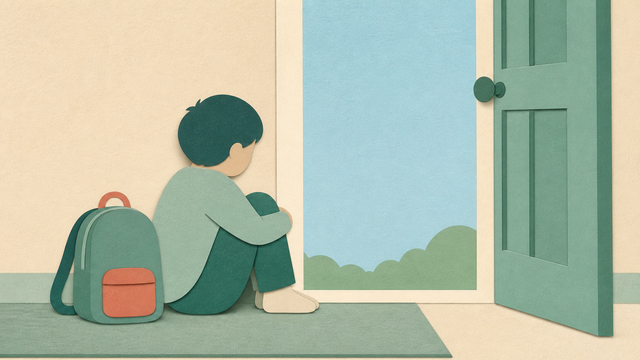
When a reaction is wildly out of proportion to what set it off, the thing that set it off is rarely the cause. It’s the last item on a pile your child has been carrying since 8 a.m. — the friend who wouldn’t play at recess, the math worksheet that felt impossible, the scratchy tag, the missed nap, the cafeteria at full volume. Each one was survivable alone. Together they used up everything your child had.
The green cup is just where the pile gives way.
Which explains something parents find genuinely unfair: the meltdown almost always happens at home, at the end of the day, with you. Kids hold it together in the places that feel risky and come apart in the place that feels safe. Being the site of the explosion is, in an annoying way, a compliment. Cold comfort at 5:30 on a Tuesday. Still true.
Showing a feeling instead of saying it
Here’s the other half of it. Children who don’t yet have words for a feeling show it instead.
An adult at the end of a depleting day can say “I’m at my limit, I need ten minutes.” A six-year-old in the identical internal state has no such sentence available. What they have is behavior. The feeling is real and it is large, and it comes out the only door it can find — which looks, from the outside, like an unhinged response to drinkware.
This is why it helps to think of outbursts as communication rather than strategy. Clinicians who work with severe tantrums make the same point: a good deal of what parents read as deliberate is far less voluntary than it appears (Child Mind Institute). A manipulating child is working toward something. A melting-down child has stopped being able to work toward anything at all.
What helps in the moment
Not reasoning, unfortunately. A child mid-outburst is past the point where logic lands — the thinking parts of the brain have temporarily handed the controls to the alarm system. Explaining why the cup doesn’t matter is both true and useless.
What tends to help is less. Fewer words, calm presence, safety, time. “I’m right here. You’re having a big feeling. I’ll stay with you.” Pediatricians offer the same short list for surviving tantrums gracefully, right down to knowing your child’s limits before you get there (HealthyChildren.org).
The teaching moment you’re itching to have comes later, once everyone is back in their body. That’s when a child can actually hear “that was a rough afternoon, huh — what was the hardest part?”
The longer project is building the vocabulary, so the feeling has somewhere to go besides behavior. A kid who can say “I had a bad day and I’m all used up” needs the cup argument much less often. That vocabulary can be taught. It’s one of the most common things we work on with children, and it takes longer than parents hope and less time than they fear.
When it’s worth extra support
Every child has outbursts. Standard equipment. It’s worth a conversation when the pattern shifts — meltdowns getting more frequent or more intense rather than gradually less, lasting a long time, showing up across settings including ones where your child used to cope, or leaving your child ashamed afterward without anything improving.
None of that automatically means something is wrong. It means the pile may be heavier than it looks, and it’s worth finding out what’s on it. That’s a job a child therapist is well set up for — often through play, which is how children tell you what they can’t yet say.
If the outbursts at your house have stopped making sense, we can help you find the pile underneath them. Get started, or ask for a call and we’ll think it through with you. Learn more about child counseling at Austin Mindfulness Center.