What Your Teen’s Therapist Will Tell You — and What Stays Private
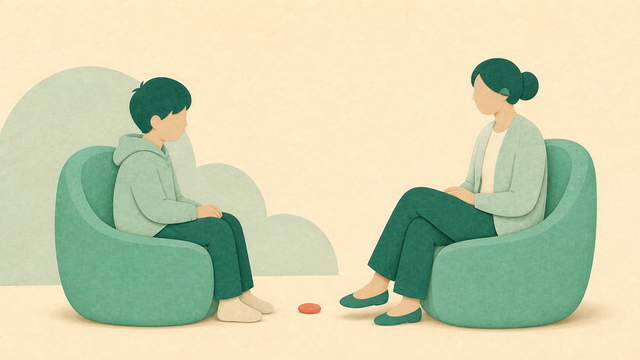
You found the therapist. You’re driving to the appointments and paying for the hour. And you will not be told most of what happens in it. For some parents that lands as a relief; for many it lands as a quiet insult — I’m handing my struggling kid to a stranger and getting locked out of the room.
That reaction deserves a straight answer, not a brush-off. So: how confidentiality in teen therapy works, why it’s built this way, and where the wall has a door in it.
Privacy is the mechanism, not a perk
Teen therapy runs on the teen telling the truth, and teens do not tell the truth into a pipeline that ends at their parents.
Think about what your teen most needs to say out loud. Some of it is about friends and school. Some of it is about you — not because you’ve failed, but because you’re a load-bearing wall in their life, and load-bearing walls generate feelings. Some of it is the stuff they’re most ashamed of, which is precisely the stuff that most needs air. A teenager who believes each session gets reported home will do what any of us would do in a monitored room: perform. You’d then be paying for fifty minutes a week of your teen managing an adult’s impression of them. A skill they already have.
The privacy isn’t the therapist siding with your kid against you. It’s the thing that makes the room worth driving to.
What you do get
Locked out of the transcript is not locked out of the process.
The shape, not the contents. Themes and direction — “we’re working a lot on anxiety around school,” “things with the friend group are heavy right now” — plus a sense of engagement and progress. No quotes, no details, no replay.
A clear agreement up front. In the first session or two, the therapist should lay out the ground rules with you and your teen in the room together, so everyone hears the same terms and nobody is guessing. If a practice can’t articulate its confidentiality policy plainly, notice that. The American Academy of Child and Adolescent Psychiatry’s Facts for Families guides are a useful outside reference for what these ground rules typically cover.
A channel in. Confidentiality limits what flows out; it doesn’t block what flows in. If you’re seeing something at home — sleep gone sideways, a friendship blowing up, a change in eating — tell the therapist. They can use it. What they generally won’t do is report back on what your teen said about it, and they’ll be transparent with your teen about what you’ve shared rather than holding secrets in either direction.
Periodic parent check-ins, at many practices, sometimes with your teen present — focused on supporting the work at home rather than on disclosure.
The safety exception, plainly
Now the part the worried 2 a.m. version of you is really asking about. The privacy has a hard limit, and the limit is safety.
If a therapist believes your teen is at risk of seriously harming themselves, is a danger to someone else, or is being harmed or abused, confidentiality yields. You will be brought in, and in some situations the law requires the therapist to act whether or not anyone consents. Your teen hears this at the very start, before they’ve shared anything, in plain language — so it never arrives as a betrayal. Where possible, a good therapist involves the teen in the telling: this has reached the level where your parents need to know; let’s figure out how they hear it.
The deal, as simply as we can put it: you won’t hear the secrets. You will always hear about danger. The therapist is not choosing between your teen’s trust and your teen’s life; the structure exists so they never have to.
A note for the meantime, since some parents reading this are already scared: the existence of a therapist doesn’t retire your own judgment. If your teen says something that frightens you — talk of not wanting to be here, of everyone being better off without them — you don’t need to wait for a session or wonder whose lane it is. Call the therapist, or call or text 988, that day.
Months in, a surprise
The confidentiality you disliked often ends up serving you. Teens who trust the room use it — very commonly, to work on the relationship with you. A lot of what a teen practices in private is a harder, truer conversation they eventually have at your kitchen table. You weren’t in the room. You were, more often than you’ll ever know, the topic. And the beneficiary.
If you’re weighing therapy for your teen and this is the part that’s been nagging at you, ask us about it directly — it’s a conversation we have all the time. Get started, or ask for a call. Learn more about teen counseling at Austin Mindfulness Center.