
Will My Teen Even Talk to a Therapist?
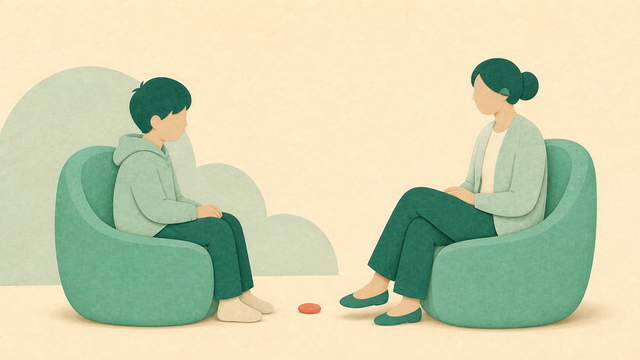
You’ve decided therapy might help. Congratulations — that was the easy part. Now you’re picturing the actual scene: your teen, who currently communicates with you in shrugs, sitting across from a stranger for fifty minutes. “I’m not going.” Or the compliance version, which is somehow worse: they go, they sit, they say “fine” on a loop while you pay for the silence.
This is the single most common worry parents bring to a first phone call. So, an honest answer.
Probably yes — and not because of anything you’ll say
The teens who arrive under protest, arms folded, announcing they don’t need this? A large share of them are talking within a few sessions. Not because teen therapists have a trick. Because of something structural: the therapist is not you.
Your teen’s reluctance usually isn’t about talking. It’s about what talking to the adults in their life costs — disappointing you, worrying you, having their words come back at dinner, being managed. A therapist is an adult with none of those strings. No grade to give, no punishment to hand down, no feelings to protect, and, as they’ll explain in the first session, no pipeline back to you except for safety. For a lot of teens that’s a genuinely novel offer. Many have never once had an adult’s full attention without an agenda attached.
It takes a few sessions to test whether the offer is real. The testing phase — short answers, monosyllables, checking the clock — is not failure. It’s the assessment. Good teen therapists expect it and don’t rush it.
What a therapist does with a silent kid
Not sitting in the quiet waiting for a breakthrough, and not interrogating. Early sessions with a reluctant teen tend to look unremarkable on purpose: conversation about the game, the show, the thing they actually care about. Sometimes a walk, a card game, something to do with hands. That’s the work, not a stall. Trust with teenagers gets built sideways, and a therapist who’s genuinely curious about your teen’s actual life — rather than fishing for the problem — is demonstrating the one thing that matters: this room is different. Decades of research say the relationship itself does much of therapy’s heavy lifting, which the American Psychological Association’s overview of psychotherapy covers in more depth.
A teen who “won’t open up” is still communicating plenty, and therapists are trained to work with what’s in the room rather than requiring confession on a schedule.
Raising it without starting a war
Frame it as support, not correction. “You’ve seemed like you’re carrying a lot, and I want you to have someone in your corner who isn’t me” lands entirely differently than “we need to fix what’s going on with you.”
Give real choices inside the non-choice. You can hold the decision that therapy is happening while handing over genuine control: which therapist (let them read bios and pick), in-person or online, what day. Teens cooperate at dramatically higher rates with things they had a hand in choosing.
Propose an experiment, not a sentence. Try three or four sessions; if they genuinely hate it after that, you’ll rethink. This is honest — fit matters, and a teen who loathes their therapist after a fair trial should get a different one, not a lecture. Knowing there’s an exit makes the entrance smaller.
Don’t oversell. “It might be useful to have somewhere to put all this” beats a speech about transformation. Teens are allergic to being sold to.
If they truly refuse
You still have moves. Parent consultation — you meeting with a therapist about how to support your teen — is a real and useful starting point, and it sometimes softens the ground. Teens have a way of getting curious about the appointment happening about them without them. And refusal today is not refusal forever; the door tends to reopen at the next hard moment, provided it was left open kindly rather than slammed in frustration.
The goal this week isn’t a talking teen. It’s a teen who knows the option exists and doesn’t have to lose a fight to use it.
If you’re weighing this and want to talk through how a first session with a reluctant teen actually goes, ask us — it’s our most-practiced conversation. Get started, or ask for a call. Learn more about teen counseling at Austin Mindfulness Center.