
Teen Counseling in Austin, TX
Empower Adolescent Potential
The teenage years pile on pressure from every direction — school, friends, screens, the future. Therapy gives your teen a place that’s entirely theirs: to sort out what’s happening, build real skills, and find their footing. And yes — we’re good with reluctant teens.

4.9★
Average rating in our most recent client survey
15 years
Serving Austin families since 2011
4,000+
Clients served
30 therapists
With varied licensure and levels of experience
Meet Shelly.Room to breathe, and someone to listen.
Brevity is wit.
Sees clients in person at our North Austin office in Northwest Hills, and online.


Karla Chamberlain, LMFT
Licensed Marriage and Family Therapist
I help others quiet the noise so they can connect with inner wisdom and live with purpose.

Emma Lapin, LPC-A
Licensed Professional Counselor Associate
I’m here to meet you where you are and work alongside you toward meaningful change.

Giselle Otamendi, LCSW
Licensed Clinical Social Worker
I'm bilingual and proudly Latina.

Kristy Demers, LCSW
Licensed Clinical Social Worker
I recharge by meditating, getting outside, and being with people who lift me up.

Karla Corro, LPC
Licensed Professional Counselor
I love time with my three dogs and husband — hikes and road trips!

Jadese Jasper, Internship Student
Supervised by
Marla Sanderson, LMFT‑SI love meditation, music-filled dog walks, new recipes, and history rabbit holes.

Jinjin Lu, LPC-A
Supervised by
JonTayé Bonds, LPC‑SAustin native — pickleball, rom-coms, and “summer days” (matcha included).

Susan Thompson, MA, LPC
Therapist, LPC
I love Barton Springs, Longhorn Football and being a mom. Probably in the reverse order.











Looking for a therapist? We’ll help you find a perfect match.
Our therapist finder makes it easy. It’s free, there’s nothing to sign up for, and it takes about a minute.
- Narrow by insurance, availability, and how a therapist works
- Save the ones you want to come back to
- Or just describe what you’re going through, and let it find the fit
Navigate Complex Challenges
Peer pressure, academic demands, and the constant comparison engine in their pocket — teens carry more than they say. What we hear from parents most often:
- Grades sliding, or motivation that’s simply vanished
- Anxiety about school, friends, or the future
- Withdrawal to their room and their phone
- Irritability that turns every conversation into a standoff
- Sleep schedules that are completely upside down
- A confidence dip you can see but can’t reach
Not sure if it’s normal teenage weather or something more? Reach out — a short conversation with our team can tell you a lot, with no commitment.


Encourage Self-Discovery
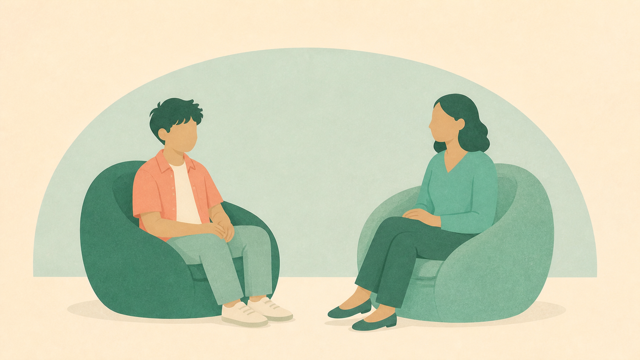
Adolescence is when identity gets built. Therapy gives teens a secure, non-judgmental space to explore who they are — values, passions, fears — with an adult who isn’t grading them, raising them, or comparing them to anyone.
Will my teen even talk to a therapist?
Very often, yes — once it’s clearly their space. Plenty of teens arrive with their arms crossed, and our therapists expect that; nobody is forced to spill anything on day one.
We start where the teen is — music, games, school, whatever’s real — and let trust build at their pace. Reluctance usually softens once they realize the therapist works for them, not for their parents.
Wondering if yours would engage? Ask for a call — we’ll tell you plainly what we’d try.


Build Emotional Resilience
Stress and setbacks are inevitable; being flattened by them isn’t. Your teen learns practical tools — mindful breathing that works in a hallway, journaling, naming what’s actually happening in the moment — practiced until they hold up under real pressure.
These are the same mindfulness skills we teach adults; teens get the unwatered-down version, and it tends to earn their respect.


Strengthen Communication
Assertive communication reduces conflict at home and with friends. We help teens say what they mean without the blowup — and help you hear what’s underneath the one-word answers.
What will my teen’s therapist tell me — and what stays private?
We’re straight with both of you about this, because trust is the whole ballgame. Your teen gets real privacy: the day-to-day content of sessions stays in the room — that’s exactly why therapy works with this age group.
You get what you actually need: regular updates on themes and progress, concrete things that help at home, and immediate contact if there is ever a safety concern — always, no exceptions.
We explain these rules to your teen in the first session, with you there, so nobody has to wonder where the lines are.
Want the specifics for your situation? Ask for a call.



Prepare for the Future
College, work, independence — every transition lands easier with self-awareness and a calm nervous system. Therapy now isn’t just about this semester; it’s the foundation for the adult your teen is becoming.
We work with several insurance plans and offer clear self-pay rates — see Rates & Insurance, or get in touch and we’ll check your coverage before you begin.
The Teen Therapy Journey
From first call to confident goodbye — here’s the whole arc.
1Reach out
A short, low-pressure conversation about what’s been going on. It takes just a few minutes, and there’s no commitment.
2Get matched
Our therapist finder pairs your teen with the best-fit therapist — because a teen who clicks with their therapist actually talks.
3Everyone in the room
The first meeting usually includes you. We set expectations together — including the privacy rules — so your teen knows this space is theirs.
4Sessions that don’t feel like class
Real conversation and real skills — stress, friends, identity, motivation — at your teen’s pace, not a curriculum’s.
5Review, grow, graduate
We track progress with you, respect their privacy, and say so when they’re ready — confidence that lasts is the summit.
How We Work With Teens
Every teen is different, so your therapist draws from several evidence-based approaches and follows your teen’s lead.
Mindfulness-based therapy
Noticing thoughts and feelings without being run by them — the skill underneath staying calm under pressure. Every AMC therapist is also a trained mindfulness teacher.
CBT that respects their intelligence
The link between thoughts, feelings, and actions — examined with care, without worksheets that talk down to them.
Values & identity work
Who am I, what matters to me, what do I want — explored with curiosity instead of pressure, and without a deadline.
Stress, sleep & screens
Practical work on the big three: academic load, a phone that never sleeps, and a body that needs to.
Parent involvement, without surveillance
Regular check-ins on themes and progress — never a transcript. You stay informed; your teen stays honest in the room.
EMDR for teens
For teens carrying something heavy, EMDR helps the memory lose its charge — paced carefully, always with consent.
Find the right therapist for your teen
Choose whichever way feels easier. Scroll down to meet the AMC therapists who work with teens and request someone by name.
Or answer a few questions in our therapist finder, and we’ll suggest therapists whose experience and availability may fit your family’s needs.

What our clients are saying about us
The breathing technique, being gentle to myself, and learning to recognize when I am not living in the present moment, among other coping skills my therapist has been teaching me have helped me tremendously with anxiety. She is easy to talk to, gentle, and listens without judgement. I am so thankful I found her and recommend her to everyone.
Frequently Asked Questions About Teen Counseling
For parents and teens alike, here are the questions we hear most.
How do I know if my teen needs therapy or is just being a teenager?
It’s hard to tell from the outside, and wondering already shows how closely you’re paying attention. Moodiness that comes and goes is part of growing up. It’s worth a closer look when a low or irritable mood lasts a couple of weeks or more, or spills into grades, sleep, friendships and the things they used to enjoy. What depression looks like day to day can help you compare, and you don’t need to be sure before you reach out.
What if my teen doesn’t want to go to therapy?
That’s very common, and it doesn’t mean therapy won’t help. A teen’s “no” is often less about refusing help and more about feeling pushed, worrying that something is “wrong” with them, or fearing their words will be reported back. Giving them a real say helps: browsing our therapists together, choosing online or in person, or agreeing to try a few sessions first. Our therapists expect some crossed arms on day one and never rush a teen to open up.
Will the therapist tell me what my teen says in sessions?
This is one of the biggest worries for parents and teens alike. In general, the details of what your teen shares stay private, because a teen who feels safe is a teen who talks. Parents hear about overall themes and progress, and the therapist reaches out right away if there’s ever a safety concern. Your teen’s therapist explains these limits at the start, with everyone present. What your therapist reports back walks through it in more detail.
Will I be involved in my teen’s therapy?
Yes, in ways that support your teen without taking over their space. Teens tend to do better when parents are part of the process. That might mean joining part of the first meeting, occasional parent check-ins, or ideas you can use at home so you’re using the same words your teen is learning. You won’t get a transcript, and you won’t be lectured. Think of it as being on the same team, with your teen’s trust at the center.
What happens at the first appointment?
It’s natural for both of you to feel a little nervous. The first meeting usually includes you and your teen, at least for part of the time. The therapist learns what’s been going on, explains how privacy works, and asks your teen what they’d like to be different. There are no tests to pass, and nothing has to be shared before they’re ready. Here’s what actually happens in a first session, so nobody walks in guessing.
How long does teen therapy usually last?
Every teen is different, so there isn’t one timeline, which can feel unsettling when you just want things to get better. Most teens meet weekly to start. A focused concern, like school stress or a recent change, may take a few months; something heavier may need support over a longer stretch. The therapist checks in with you both along the way, and how you’ll know therapy is working describes the signs to look for.
Can my teen do therapy online?
Yes. For many teens, talking from a familiar space feels easier than walking into an office, and it fits around school and activities without a drive across town. We offer secure online therapy anywhere in Texas, and about half our clients meet online. If your teen would rather meet in person, we have offices in North Austin and South Austin, and some families mix the two.
How do we choose the right therapist for my teen?
The relationship matters a lot with teens, so it’s worth taking a little time. Look for someone who works with your teen’s age and the concerns you’re seeing, like anxiety or depression, then let your teen weigh in on who feels right. You can filter by insurance and availability, or simply describe what’s going on, in our therapist finder. If the first match doesn’t click, it’s okay to say so and try someone else.
Does insurance cover teen counseling, and what does it cost?
Money questions are part of deciding, so please ask them. We accept several plans for individual counseling, including Aetna, BCBS-TX, Cigna and Optum (Oscar, Oxford, UnitedHealthcare); see every plan we take. Medicaid and Medicare aren’t accepted, and insurance doesn’t cover couples or family sessions. Self-pay rates run $75 to $200 a session. Call or text (512) 578-8070, or find your fit in about a minute with our therapist finder.
I’m a teen. How do I tell my parents I want to talk to a therapist?
Asking for help takes courage, and it says something good about you. You don’t need a perfect speech. Pick a calm moment and try: “I’ve been feeling stressed (or down) for a while, and I think talking to someone could help.” A text or note works too. If you’re wondering whether it’s “bad enough” for therapy, it doesn’t have to be. If you’re ever thinking about hurting yourself, call or text 988, or call 911 if you’re in immediate danger.
Still have questions?
Whether you’re wondering about insurance, choosing a therapist, or getting started, our team is here to help.
Call or text (512) 578-8070Monday–Friday, 9 a.m.–5 p.m.